|
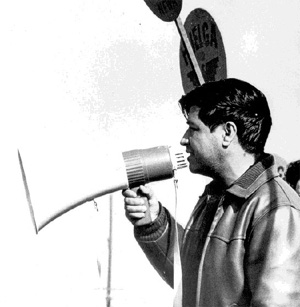
The United Farm Workers of America (UFW) was formed in 1966, when the AFL-CIO-affiliated Agricultural Workers Organizing Committee (AWOC) merged with the National Farm Workers Association (NFWA). Under the leadership of Cesar Chavez, UFW efforts to organize grape pickers on individual farms quickly escalated to include a boycott of all non-union grapes. Chavez and the UFW brought attention to their boycott by a number of means, including hunger strikes and marches, and the UFW also campaigned for Robert F. Kennedy's presidential bid in 1968. By 1970, the grape campaign had ended in successful union contracts, and the UFW began focusing its efforts on lettuce, citrus, and, eventually, garlic workers. Chavez was temporarily jailed for refusing to end the lettuce boycott, but high-profile visitors such as Ethel Kennedy and Coretta Scott King merely brought attention to the UFW cause. In 1973, the grape workers' contract came up for renewal, leading to strike. Non-violent strikers were arrested and beaten, and two were murdered. Chavez called off the strike, and the UFW launched a second grape boycott. By 1975, 17 million Americans were boycotting grapes. Under pressure from the UFW and from supermarket interests, California Governor Jerry Brown intervened, promising to guarantee workers' right to organize and to oversee union elections. The UFW won many of the elections and called off their grape boycott. Throughout the 1970s, the UFW won a number of individual contracts; however, they did not achieve a decisive, industry-wide victory. |
|
INFORMATION
UFW Homepage
PHOTOS
Cesar Chavez Research Center